If your website isn't showing up on the first page of Google, it might as well not exist.
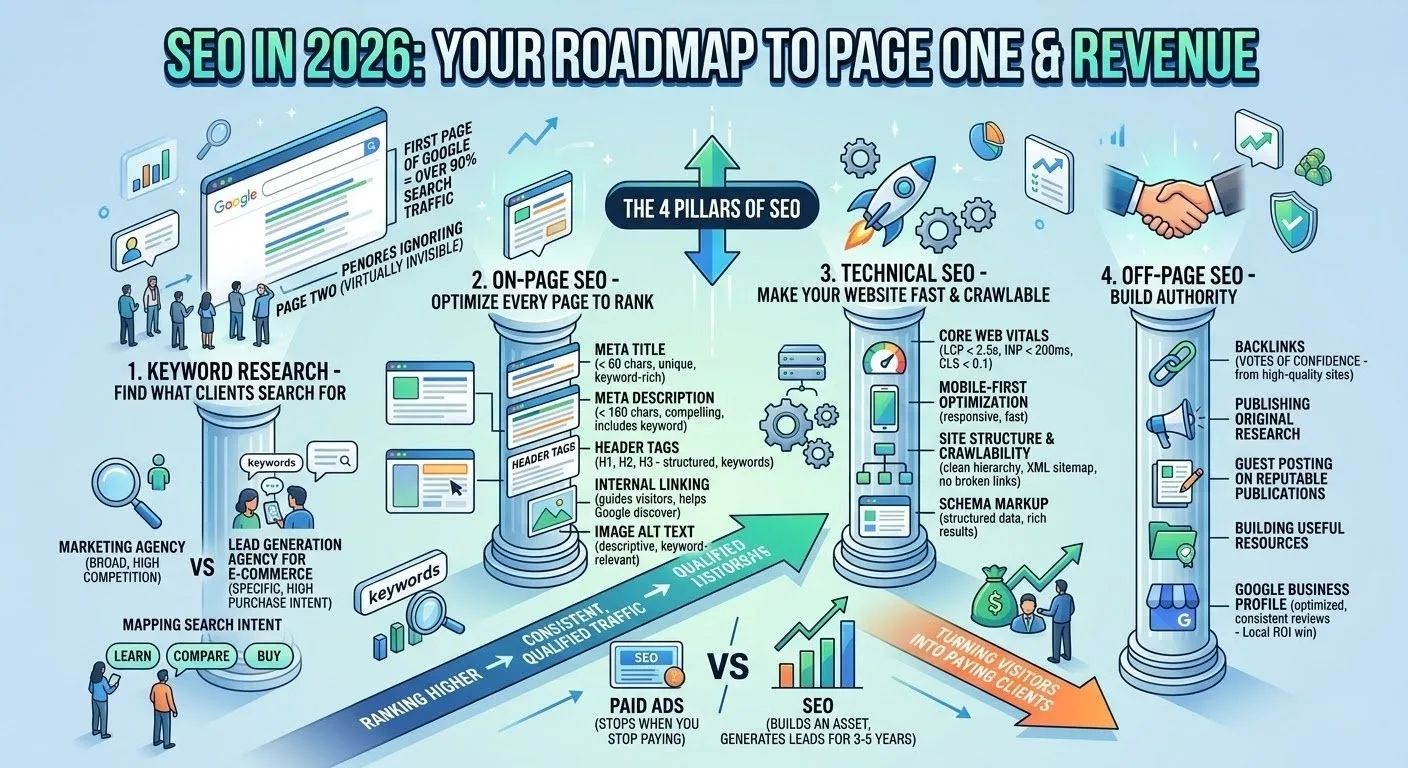
Over 90% of all search traffic goes to page one results. Businesses sitting on page two — regardless of how good their service is — are virtually invisible to the people actively searching for what they offer. Search Engine Optimization (SEO) is the system that determines where you land. And in 2026, getting it right has never been more critical.
Here's everything you need to know to start ranking higher and generating consistent, qualified traffic — without paying for every single click.
Why SEO Matters More Than Ever in 2026
Organic search is the highest-intent traffic channel available. Unlike social media — where you're interrupting someone's scroll — search traffic comes from people actively looking for a solution. They already have the problem. You just need to be the answer they find.
The cost advantage is also compounding. Paid ads stop the moment you stop paying. SEO builds an asset — ranked content that continues generating leads long after the work is done. A well-optimized blog post published today can bring in qualified clients for the next three to five years.
The 4 Pillars of SEO Every Business Needs
1. Keyword Research — Find What Your Clients Are Actually Searching For
Every effective SEO strategy starts with keyword research — identifying the exact words and phrases your ideal clients type into Google when they have a problem you can solve.
Most businesses target keywords that are too broad. "Marketing agency" gets millions of searches — but it also has millions of competitors. The smarter approach is long-tail keywords: longer, more specific phrases with lower competition and higher purchase intent. Someone searching "lead generation agency for e-commerce" is far more likely to convert than someone searching "marketing."
Effective keyword research means mapping search intent — understanding whether someone is looking to learn, compare, or buy — and creating content that matches that intent precisely.
2. On-Page SEO — Optimize Every Page to Rank
On-page SEO covers everything within your own website that influences rankings. The essentials:
- Meta Title — A unique, keyword-rich title under 60 characters for every page. This is the first thing searchers see in Google results.
- Meta Description — A compelling summary under 160 characters that includes your primary keyword and gives people a reason to click.
- Header Tags (H1, H2, H3) — Structure your content logically. Your H1 should include your primary keyword. Subheadings should naturally incorporate secondary keywords.
- Internal Linking — Every page should link to other relevant pages on your site. This helps Google discover your content and guides visitors toward conversion.
- Image Alt Text — Every image needs a descriptive, keyword-relevant alt tag. It contributes to image search rankings and improves accessibility.
3. Technical SEO — Make Your Website Fast and Crawlable
Great content won't rank on a technically broken website. The technical priorities that matter most in 2026:
Core Web Vitals — Google uses these three performance metrics as direct ranking factors. Your pages need to load fast (LCP under 2.5s), respond quickly to interactions (INP under 200ms), and remain visually stable as they load (CLS under 0.1).
Mobile-First Optimization — Google indexes the mobile version of your site first. If your site isn't fully responsive and fast on mobile, you're being penalized regardless of your desktop experience.
Site Structure & Crawlability — A clean page hierarchy, properly configured XML sitemap, and zero broken links ensure Google can efficiently find and index all your important pages.
Schema Markup — Structured data that helps Google understand your content context and makes your listings eligible for rich results — dramatically improving click-through rates.
4. Off-Page SEO — Build Authority That Drives Rankings
Off-page SEO is everything outside your website that influences how Google perceives your trustworthiness. The most important factor is backlinks — links from other websites pointing to yours.
Every backlink is a vote of confidence. The more high-quality sites linking to your content, the more authority Google assigns to your domain — and the higher you rank.
The backlink strategies that work best in 2026 are publishing original research that others cite, guest posting on reputable industry publications, and building genuinely useful resources that naturally attract links over time.
For service businesses and local brands, a fully optimized Google Business Profile with consistent reviews is one of the fastest and highest-ROI SEO wins available — and one of the most commonly overlooked.
The SEO Mistakes Silently Killing Your Rankings
Before you go, here are the most common errors suppressing your rankings right now:
- Targeting keywords that are too broad and too competitive
- Publishing short, thin content that doesn't genuinely help the reader
- Ignoring Core Web Vitals and page speed
- No internal linking strategy connecting your pages
- Inconsistent publishing that signals a neglected site to Google
- A neglected or incomplete Google Business Profile