An eBay marketing strategy is the difference between a shop that quietly generates consistent income and one that sits mostly invisible despite having solid products at fair prices.
Most new sellers approach eBay the same way. They list a product, set a price, upload a couple of photos, and hope buyers find them. Sometimes they do. Most of the time, they do not — and the seller concludes that eBay is too competitive, too saturated, or simply not worth the effort.
That conclusion is almost always wrong. The problem is not the platform. It is the absence of a deliberate strategy behind the listings.
eBay has over 1.7 billion active listings at any given time. Buyers searching for a product are not browsing through all of them. They are being shown a curated set of results by eBay's search algorithm, called Cassini, which decides which listings best match what a buyer is looking for and which sellers are most likely to deliver a positive purchase experience.
Understanding how Cassini works, and building your listings and seller account around what it rewards, is the foundation of every effective eBay marketing strategy. This guide covers everything a new seller needs to know to get started on the right foot.
Understanding eBay's Cassini Search Algorithm
Before optimizing anything, you need to understand what eBay is trying to do when a buyer runs a search.
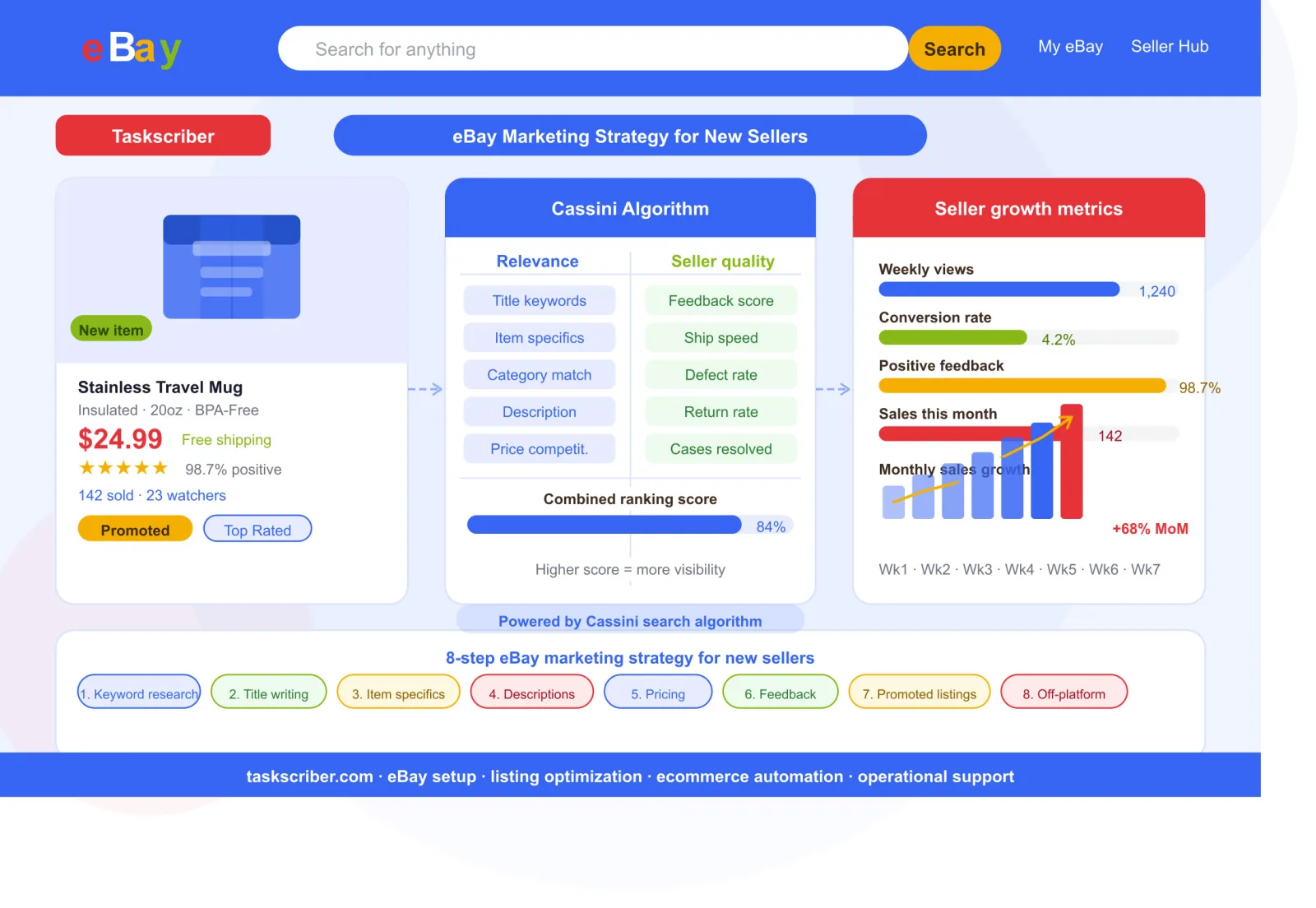
Cassini is designed to connect buyers with the listings most likely to result in a completed, satisfying transaction. That means it looks at two things simultaneously: relevance and seller quality.
Relevance measures how closely your listing matches what the buyer searched for. Cassini scans your title, item specifics, category, and description to determine whether your product is genuinely what the buyer is looking for.
Seller quality measures how trustworthy and reliable you are as a seller. Cassini considers your feedback score, transaction defect rate, late shipment rate, cases closed without seller resolution, and your overall selling history to determine how much confidence it has in surfacing your listings to buyers.
This is a critical point that most new sellers miss. Two listings for identical products can differ dramatically in search visibility not because of their content, but because one seller has a stronger performance record than the other. Building a strong seller account from day one — through accurate listings, fast shipping, responsive communication, and zero defects — is as important as keyword optimization.
Step 1: Keyword Research for eBay Listings
Every effective eBay marketing strategy starts with understanding how your buyers search. Not how you would describe your product — how someone who wants to buy it types their query into the eBay search bar.
These two perspectives are often very different, and the gap between them is where most new sellers lose visibility.
Use eBay's own search bar for research. Start typing a word or phrase related to your product and pay close attention to the autocomplete suggestions that appear. These are real searches that real buyers are making right now. Every suggestion is a keyword opportunity. Make a thorough list of every relevant phrase that appears.
Study completed listings. eBay's advanced search allows you to filter for sold listings. Search for your product and filter to show only completed sales. The listings that sold — especially those with the highest prices or fastest sale times — have titles and item specifics that clearly work. Study them carefully. Note the exact phrases they use, the order words appear in their titles, and the item specifics they include.
Use eBay's keyword tool and third-party research tools. Tools like Terapeak, which is built into eBay's Seller Hub, show you what buyers are searching for, which keywords drive the most sales in your category, and what average selling prices look like. This data removes guesswork and gives you a factual foundation for your keyword strategy.
Focus on buyer language, not seller language. Sellers describe products by their technical specifications. Buyers search by what something does, what problem it solves, who it is for, or what occasion it fits. A seller might describe a product as a "stainless steel insulated double-wall travel tumbler." A buyer searches for "coffee mug that keeps drinks hot" or "travel mug gift for dad." The gap between these two descriptions is where rankings are lost.
Step 2: Writing eBay Titles That Rank
Your listing title is the single most important element in your eBay SEO. It carries more weight than any other part of your listing in Cassini's relevance calculation, and it is the first thing buyers see in search results — making it equally important for click-through rate.
eBay allows up to 80 characters in a listing title. Use every single one.
Lead with your most important keyword. Cassini gives slightly more relevance weight to keywords that appear earlier in the title. Put your primary search term at the beginning, not buried at the end.
Include the most searchable version of your product name. Think about what a buyer who has never heard of your specific brand or product line would type to find something like what you are selling. Use that language.
Add condition, key attributes, and relevant secondary keywords. After your primary keyword, include the condition of the item, its most important attributes — size, color, model number, compatibility, material — and any secondary keywords that represent how different buyers might search for the same product.
Avoid wasting title space on punctuation, promotional language, or irrelevant filler. Words like "Look," "Wow," "L@@K," "Free shipping," and exclamation marks do nothing for your search visibility and take up space that could be used for keywords that actually help buyers find you.
A strong eBay title reads like a specific, information-dense product description rather than a marketing headline. It should answer the question: exactly what is this thing and what are the most important things a buyer needs to know about it to decide whether to click?
Step 3: Item Specifics — The Most Underused eBay SEO Tool
Item specifics are the structured data fields — brand, size, color, model, material, compatibility, and so on — that eBay asks you to fill in when creating a listing. Most new sellers either skip them entirely or fill in only the minimum required fields.
This is one of the most costly SEO mistakes a new eBay seller can make.
Cassini uses item specifics extensively for relevance matching. When a buyer uses eBay's filter system to narrow their search — filtering by size, color, condition, or brand — listings without complete item specifics are excluded from those filtered results entirely. You cannot rank for a filtered search you are not technically present in.
Fill in every item specific that eBay offers for your category, even the optional ones. The more complete your item specifics, the more search queries your listing can appear for, and the more buyer filter combinations will surface your product.
When eBay suggests recommended values for item specifics, use their suggested terminology rather than your own phrasing. Cassini is designed around the vocabulary eBay recommends, and using matching language strengthens your relevance signals.
Step 4: Writing Listing Descriptions That Convert
While your title and item specifics drive search visibility, your listing description is what converts browsers into buyers. A visitor who finds your listing through search is already interested — your description needs to close the gap between interest and purchase.
Open with the most important information first. Many buyers skim rather than read in full. Lead with what the product is, its condition, its key specifications, and what is included in the sale. Give buyers the information they need to make a decision before they have to scroll.
Be specific and honest about condition. Particularly for used, refurbished, or vintage items, detailed condition descriptions build trust and reduce disputes. Describe exactly what the buyer will receive, including any wear, scratches, missing parts, or imperfections. Buyers who receive exactly what they expected leave positive feedback. Buyers who feel misled leave negative feedback — and negative feedback damages your seller standing with Cassini.
Include compatibility information where relevant. For electronics, auto parts, tools, and similar categories, clearly stating what your product is compatible with is often the deciding factor for buyers. It also adds relevant keywords to your description naturally.
Address common buyer questions proactively. Think about what a buyer would want to know before purchasing and answer it in the description. Dimensions, weight, power requirements, included accessories, warranty information, return policy — anything that removes uncertainty and builds confidence in the purchase.
Include relevant keywords naturally. While Cassini's primary focus for description content is buyer experience rather than keyword density, working your main keywords into the description naturally reinforces your relevance signals without reading as keyword stuffing.
Step 5: Pricing Strategy for New eBay Sellers
Pricing is both a business decision and an SEO factor. Cassini takes pricing into account when determining which listings to surface, favoring listings that offer competitive value relative to similar items.
For new sellers without an established feedback history, competitive pricing is especially important. Buyers weighing two similar listings from different sellers will often choose the one with more positive feedback — meaning a new seller typically needs to offer a price advantage to compensate for their unproven track record.
Research completed sales before setting your price. Terapeak and eBay's completed listings filter show you exactly what similar items have sold for recently. Price at or slightly below the market average to maximize your early sales velocity while you build feedback.
Consider the total cost of selling. eBay's final value fees, PayPal or managed payments fees, shipping costs, and packaging materials all come out of your sale price. Calculate your true net before listing so you are not inadvertently selling at a loss.
Use calculated shipping rather than free shipping where margins are tight. While free shipping can improve your competitiveness and is rewarded by Cassini to some degree, undercharging for shipping consistently will erode your margins. Calculated shipping lets buyers see an accurate cost based on their location without you absorbing the difference.
Avoid pricing below your sustainable floor just to compete. Winning the sale at a price that damages your business is not a victory. Price competitively, but always within a range that keeps your operation viable.
Step 6: Building Seller Feedback Early
For new eBay sellers, feedback is one of the most important assets you can build — and one of the most directly influential factors in your Cassini rankings.
Buyers trust sellers with established positive feedback records. Cassini favors them. And in competitive product categories, a strong feedback score can be the deciding factor that wins a sale over a lower-priced competitor with no history.
Deliver exactly what you describe, packaged well, and shipped fast. This sounds obvious, but the sellers who earn consistent positive feedback are the ones who treat every order — including a $3 sale — as an opportunity to impress. A buyer who receives a beautifully packaged item that arrived faster than expected and matches the description perfectly will almost always leave positive feedback without being asked.
Ship within your stated handling time, every time. Late shipments are one of the fastest ways to damage your seller metrics and trigger negative feedback. Set a handling time you can reliably meet and treat it as a commitment, not a guideline.
Communicate proactively when something goes wrong. Delays happen. Items occasionally arrive damaged. How you handle these situations determines whether a problem becomes a negative feedback or a story the buyer tells about the seller who went above and beyond to make things right. Reach out before the buyer does. Offer a solution immediately. Sellers who respond well to problems often convert negative situations into positive feedback.
Politely request feedback from buyers. eBay allows sellers to send a single follow-up message after a transaction. A brief, genuine message thanking the buyer for their purchase and mentioning that feedback helps your small business goes a long way. Keep it human and specific rather than generic.
Step 7: eBay Promoted Listings — Paid Visibility for New Sellers
eBay's Promoted Listings program allows sellers to pay for increased visibility in search results. For new sellers who do not yet have the organic ranking power of established accounts, Promoted Listings can be a valuable tool to accelerate early visibility while building the seller history needed to rank organically.
There are two main options within Promoted Listings.
Promoted Listings Standard charges an ad rate only when a buyer clicks your promoted listing and purchases within 30 days. You set the ad rate as a percentage of the final sale price, and higher ad rates generally result in better placement. Because you only pay on completed sales, the cost is directly tied to revenue rather than impressions — making it lower risk than most advertising models.
Promoted Listings Advanced operates on a cost-per-click model, where you set keyword bids and pay when buyers click your listing regardless of whether they purchase. This option gives you more control over targeting but requires more active management and carries the risk of paying for clicks that do not convert.
For most new sellers, Promoted Listings Standard is the better starting point. It is simpler to manage, the payment structure is tied to actual sales, and it requires no bidding expertise to run effectively.
A few practical guidelines for using Promoted Listings as a new seller. Start with your best-performing organic listings rather than trying to promote everything. Monitor your ad rate relative to your profit margins to ensure you remain profitable after fees. And treat Promoted Listings as a complement to strong organic optimization — not a substitute for it. A promoted listing with a weak title, incomplete item specifics, and poor photos will still underperform.
Step 8: eBay Store — Is It Worth It for New Sellers
eBay offers subscription-based Store plans that provide benefits like lower final value fees, additional free listings, access to more promotional tools, and a dedicated storefront page for your shop.
For new sellers just starting out, an eBay Store subscription is generally not necessary until your selling volume justifies the monthly cost. If you are listing fewer than 50 items per month, the free listing allowance and standard fee structure are typically sufficient.
As your business grows and you begin listing consistently — particularly if you are building a multi-product shop or selling in high-volume categories — an eBay Store becomes increasingly worthwhile. The fee savings on final value fees alone can exceed the subscription cost for sellers moving significant volume.
Beyond the financial benefits, an eBay Store also gives you access to markdown promotions, order discount offers, and volume pricing tools that can meaningfully improve your conversion rate and average order value. These promotional tools are among the most underused marketing levers available to eBay sellers.
Building an Off-Platform eBay Marketing Strategy
Most new eBay sellers focus entirely on on-platform optimization, which is the right priority early on. But as your shop matures, building external traffic sources amplifies everything your eBay SEO is already doing.
Google Shopping. eBay listings are indexed by Google, and many eBay products appear in Google Shopping results. Optimizing your listings for the keywords buyers use on Google — often slightly different from eBay search terms — expands your visibility beyond the eBay platform entirely.
Social media for niche products. If you sell in a category with an active enthusiast community — vintage collectibles, hobbyist electronics, specialty tools, craft supplies — social platforms where those communities gather can be powerful traffic sources. Facebook Groups, Reddit communities, and niche Instagram accounts are all potential channels for driving targeted buyers to your eBay listings.
Email marketing for repeat buyers. eBay's messaging system does not allow direct promotional emails to past buyers, but building an email list through your own website or social channels gives you a way to notify interested buyers about new inventory, sales, and special offers. Returning customers buy at a higher rate and lower acquisition cost than new ones, making this worth building even early on.
The Bottom Line
An eBay marketing strategy for new sellers is built on a clear foundation: understand how Cassini works, optimize every element of your listings around buyer search behavior, build your seller performance metrics from the first transaction, and layer in paid visibility tools and external traffic channels as your shop matures.
None of this is complicated once you know what to focus on. But it does require intention. The sellers who build profitable eBay businesses are not the ones who listed the most products or spent the most on ads. They are the ones who built the right systems from the start — optimized listings, strong seller metrics, consistent fulfillment, and a marketing approach that puts their products in front of buyers who are already ready to purchase.
If you want to build that kind of operation without figuring out every piece yourself, Taskscriber is built for exactly that kind of work. From ecommerce setup and listing strategy to full operational support and automation, we help new sellers get the foundation right from day one.