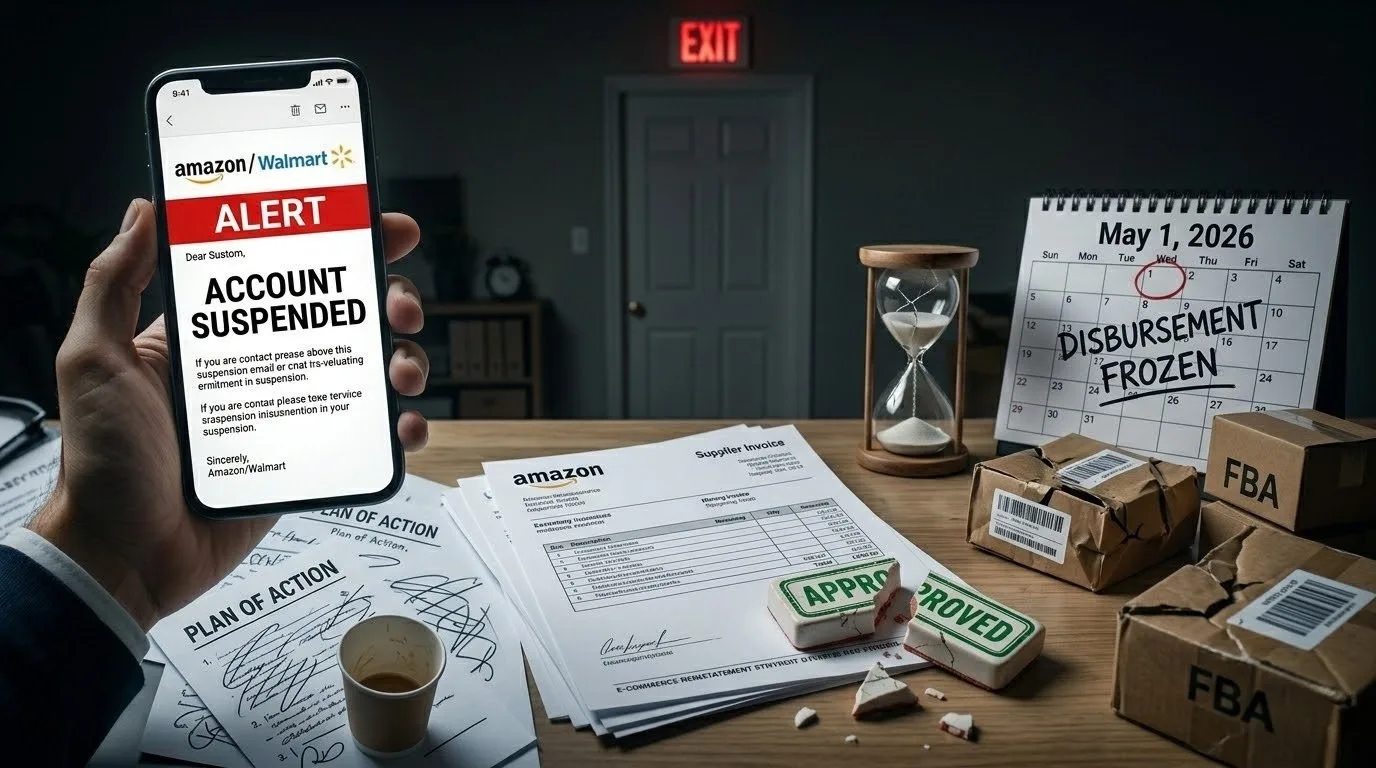
If you woke up today to a suspension notice from Amazon or Walmart, you're not alone. Every single day, thousands of marketplace sellers — many with years of spotless performance history — find their accounts suspended, their listings suppressed, and their revenue frozen without warning.
The worst part? Most of them had no idea it was coming.
Whether you're an established FBA seller doing six figures a month or a growing Walmart Marketplace merchant still finding your footing, a suspension is one of the most financially devastating events your business can experience. And yet, most sellers make it significantly worse by responding the wrong way.
This guide breaks down exactly why suspensions happen, what mistakes sellers make when trying to appeal, and what a structured reinstatement process actually looks like — so you can protect your business before a suspension hits, or recover faster if it already has.
Why Marketplace Suspensions Are More Common Than You Think
Amazon and Walmart have built their marketplaces on trust — trust that every product listed is authentic, every claim is accurate, and every order is fulfilled reliably. To protect that trust at scale, both platforms use a combination of automated enforcement systems and human review teams that monitor seller performance around the clock.
The problem is that automated systems don't exercise judgment. They flag patterns. And patterns can be triggered by things entirely outside your control — a spike in returns caused by a carrier issue, a competitor filing a bad-faith IP complaint, or a bulk listing upload that inadvertently included non-compliant product descriptions.
The most common causes of marketplace suspensions fall into four categories:
1. Performance Metric Violations Amazon and Walmart both set strict thresholds for order defect rates, cancellation rates, and late shipment rates. A fulfillment disruption — even a temporary one caused by a third-party logistics partner — can push these metrics over the limit and trigger an automatic suspension.
2. Policy & Content Violations Listing descriptions that include unverified claims ("clinically proven," "best in class," "guaranteed results"), images that don't meet platform guidelines, or product categories that require compliance documentation you haven't submitted — all of these are grounds for listing suppression or account suspension.
3. Intellectual Property Complaints IP complaints are particularly dangerous because they involve a third party. A competitor or brand owner can file a trademark or copyright infringement complaint against your listings — and Amazon or Walmart will act on it immediately, often before investigating whether the complaint is valid.
4. Authenticity & Inauthentic Item Complaints If customers or the platform suspect that your products are counterfeit or don't match their descriptions, authenticity complaints can cascade quickly. Even sellers sourcing from legitimate distributors can be caught in this net if their supply chain documentation isn't airtight.
The 3 Mistakes That Guarantee a Rejected Appeal
When sellers receive a suspension notice, the instinct is to respond immediately. That urgency is understandable — every hour of downtime is lost revenue. But speed without strategy is the single biggest reason reinstatement appeals fail.
Here are the three mistakes we see most often:
Mistake 1 — Appealing Without Understanding the Root Cause The most common reason appeals are rejected is that they don't actually address what caused the suspension. Amazon and Walmart aren't looking for an apology — they're looking for proof that you understand what went wrong and have taken specific, documentable steps to fix it. A vague appeal that acknowledges the suspension without identifying the root cause tells the review team that the problem is likely to recur.
Mistake 2 — Making Promises Instead of Presenting Proof There's a critical difference between saying "we will implement a quality control process" and saying "we have implemented the following quality control process, effective [date], including [specific steps], as documented in the attached supplier agreement." The first is a promise. The second is evidence. Review teams are trained to spot the difference, and they respond accordingly.
Mistake 3 — Using Emotional or Defensive Language A suspension appeal is not the place to express frustration, plead for sympathy, or argue that the suspension was unfair. Even if it was. Amazon and Walmart's review teams evaluate appeals on the basis of accountability, clarity, and corrective action — not emotional context. Appeals that read as defensive or confrontational are dismissed far more quickly than those that are calm, professional, and solution-focused.
What a Winning Reinstatement Process Actually Looks Like
Whether you're dealing with an Amazon suspension or a Walmart account deactivation, the reinstatement process that consistently works follows the same fundamental structure.
Phase 1 — Audit Before You Appeal. Before writing a single word of your appeal, conduct a full audit of your account. Review every metric, every flagged listing, every complaint, and every piece of correspondence. You need to understand not just what Amazon or Walmart told you went wrong — but what actually went wrong, and why. These two things are often different.
Phase 2 — Fix the Problem First. This is the step most sellers skip because they're in a rush. But submitting an appeal with corrective actions already completed — rather than promised — is one of the most powerful things you can do. It demonstrates genuine accountability and significantly increases the credibility of your submission.
Phase 3 — Build a Structured Plan of Action. A strong Plan of Action has three clearly defined sections: root cause, immediate corrective actions, and preventive measures. Each section should be specific, factual, and supported by documentation. The goal is to leave the review team with no unanswered questions about what happened, what you've done about it, and how you'll prevent it from happening again.
Phase 4 — Submit, Monitor, and Escalate When Necessary. After submission, monitor your case actively. If the standard review window passes without a response, most platforms have escalation pathways available — but knowing when and how to use them without jeopardizing your case is a skill in itself.
The Hidden Cost of Doing Nothing
Many sellers underestimate how quickly a suspension compounds into something far more serious. What starts as a temporary account hold can escalate to permanent deactivation if appeals are mishandled or if the underlying compliance issues aren't resolved.
Beyond the direct revenue loss, there are cascading effects: supplier relationships strained by unexpected order freezes, fulfillment infrastructure disrupted by listing suppression, customer trust eroded by sudden product unavailability, and frozen disbursements that can run into tens of thousands of dollars.
The sellers who recover fastest are the ones who treat a suspension not as a bureaucratic inconvenience, but as a signal that their compliance infrastructure needs to be rebuilt from the ground up — and who take that seriously from day one.
Protecting Your Account Before a Suspension Happens
The best reinstatement strategy is one you never have to use. Here are the foundational practices that significantly reduce your suspension risk on any marketplace:
- Audit your listings quarterly against current platform content policies — policies change, and listings that were compliant six months ago may not be today
- Document your supply chain with supplier agreements, invoices, and authenticity certifications for every SKU you carry
- Monitor your performance metrics weekly, not monthly — catching an ODR spike early gives you time to correct it before it crosses the threshold
- Respond to customer complaints within 24 hours — unresolved complaints compound quickly and are often the early warning sign of a larger account health issue
- Review every bulk listing upload manually before it goes live — automation errors in content uploads are one of the leading causes of policy violations
When to Bring in a Professional
Not every suspension requires outside help. But there are situations where the cost of getting it wrong — whether that's a permanent ban, extended revenue loss, or frozen disbursements — far outweighs the cost of expert support.
Consider bringing in a professional if:
- Your appeal has already been rejected once or more
- The suspension involves IP complaints from a third party
- Your frozen disbursements exceed $10,000
- The suspension notice cites multiple simultaneous violations
- You're approaching a high-revenue seasonal period and can't afford an extended downtime
At Taskscriber, we've helped sellers across Amazon, Walmart, eBay, and Etsy navigate suspensions, IP complaints, and compliance violations — building structured reinstatement strategies that don't just recover accounts, but leave them in a stronger position than before.